desigualdad: 6to Grado 🌐 View in English
Number and Operations
Numbers and Basic Operations
Vertical Alignment
TEKS:
| 5th | 5.2(B) |
| 6th | 6.2(C), 6.2(D), 6.9(A), 6.9(B), 6.9(C), 6.10(A), 6.10(B) |
| 7th | 7.10(B), 7.11(A), 7.11(B), 7.10(A), 7.10(C), 7.11(C) |
| 8th | 8.8(A), 8.8(B), 8.8(C) |
| Alg 1 | A.2(A), A.3(C), A.3(E), A.4(A), A.4(B), A.12(A), A.12(B), A.2(H), A.3(D), A.3(H), A.5(B) |
| Alg 2 | 2A.6(D), 2A.6(E), 2A.6(F), 2A.3(E), 2A.3(F), 2A.3(G), 2A.4(A), 2A.4(B), 2A.4(D), 2A.4(E), 2A.4(F), 2A.4(H), 2A.7(I), 2A.8(A), 2A.8(B), 2A.8(C), 2A.2(A), 2A.6(G), 2A.6(K) |
Linked To
Downloads
- Visual
- Word wall visual
- Lesson Plan
- Lesson Materials
Structured Conversation Questions
Observational
¿Qué es una desigualdad?
Una desigualdad es...Relational
¿En qué se diferencia una desigualdad de una ecuación?
Una desigualdad es diferente de una ecuación porque...Inferential
¿Cómo sabes si un valor satisface una desigualdad?
Sé si un valor satisface una desigualdad por...
Please log in to comment.
Students might notice in this visual:
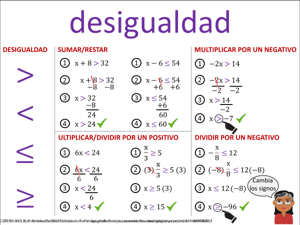
- Símbolos de desigualdad como >, <, ≥, y ≤
- Sumar o restar valores no cambia el signo de la desigualdad
- Multiplicar o dividir por un número positivo mantiene el signo de la desigualdad igual
- Multiplicar o dividir por un número negativo invierte el signo de la desigualdad
- Un personaje dice “¡Cambia los signos!” cuando se divide por un número negativo
EXTENDING THE DISCUSSION
After the observational question, randomly call on one or more students to share what they or their partner answered. Then ask the class, “Did anyone notice…?” using the suggestions above or anything else you’ve noticed.
Students might wonder:
- ¿Por qué hay que cambiar el signo al multiplicar o dividir por un número negativo?
- ¿Qué pasa si olvidamos cambiar el signo?
- ¿Puede una desigualdad usar un signo de igual?
- ¿Por qué los números positivos y negativos afectan la desigualdad de manera diferente?
- ¿Se puede cambiar el signo más de una vez en un problema?
EXTENDING THE DISCUSSION
After students have shared what they notice, ask the class, “Did anyone wonder…?” using the suggestions above or anything else you might think is interesting or relevant to the lesson.
Example student responses
To the observational question, ¿Qué es una desigualdad?
LOW-LEVEL
Una desigualdad es un problema con el signo de “mayor que” o “menor que”.
HIGH-LEVEL
Una desigualdad es una oración matemática que compara valores y puede usar símbolos como mayor que o menor que para mostrar que un lado no siempre es igual al otro.
RESPONDING TO RESPONSES
Emphasize and celebrate each student’s use of the key vocabulary to support a culture of “no wrong answers.”