Life Sciences
Evolution and Diversity
Vertical Alignment
TEKS:
| 6th | 6.13(C) |
| 7th | 7.13(D) |
| 8th | 8.13(C) |
| Bio | B.10(A)B.10(B)B.10(C)B.10(D) |
NGSS:
| MS: | MS-LS4-4 MS-LS4-6 |
| Bio: | HS-LS4-2 HS-LS4-3 HS-LS4-4 |
Linked To
Downloads
- Download Visual
- Word wall visual
- Lesson Plan
-
Lesson Materials
-
Teacher Guide
-
Leveled Reading Passages
-
Google Drive
Structured Conversation Questions
Observational
¿Qué ocurre en la selección natural?
En la selección natural, …Relational
¿Cómo está relacionada la selección natural con las variaciones?
La selección natural está relacionada con las variaciones porque…Inferential
¿Cómo contribuye el ambiente a la selección natural?
El ambiente contribuye a la selección natural en el sentido de que…
Please log in to comment.
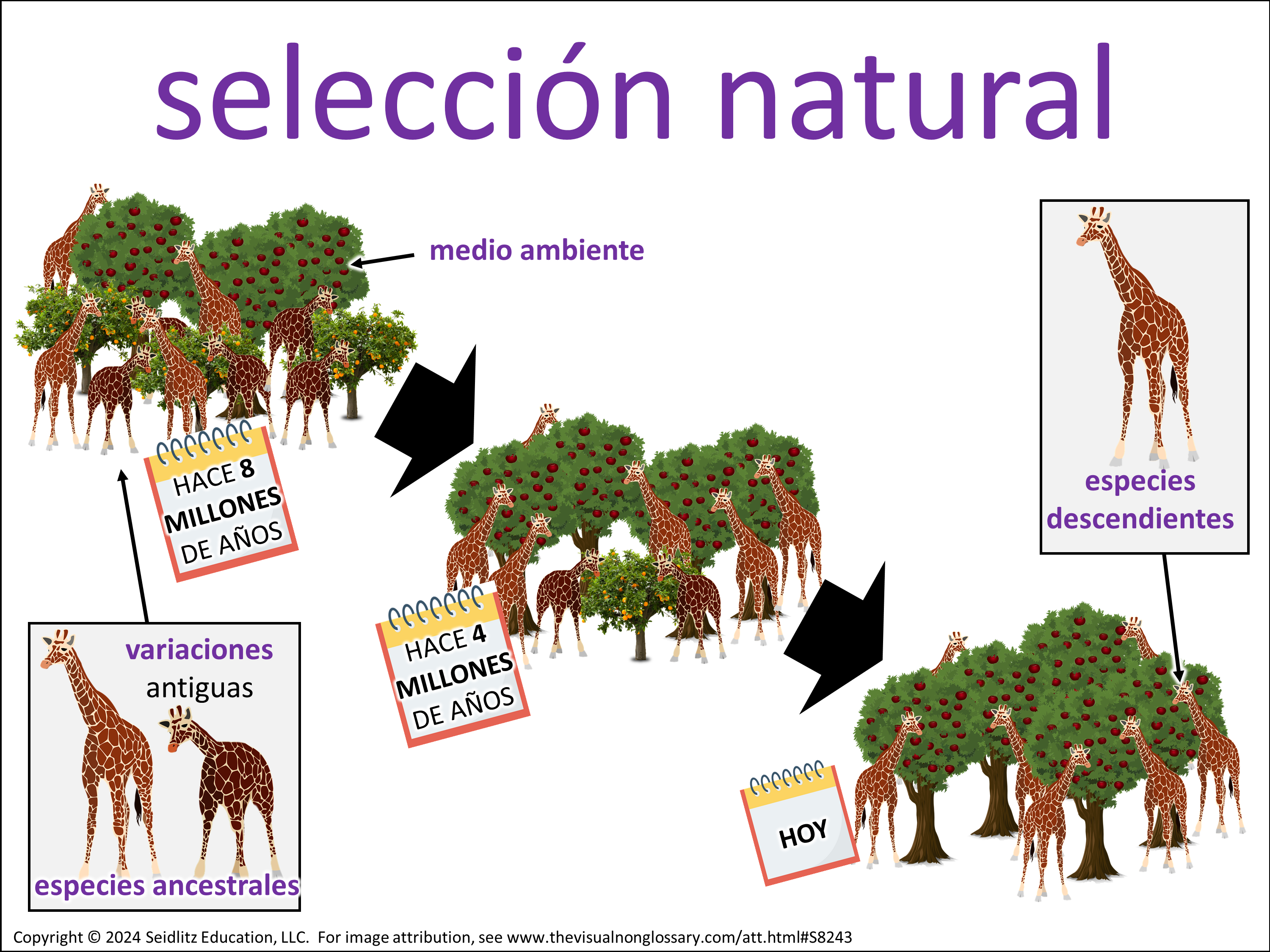
Students might notice in this visual:
- Las jirafas con cuellos más largos podían alcanzar más comida.
- Algunas jirafas en el pasado tenían cuellos más cortos.
- Los árboles forman parte del medio ambiente.
- Con el tiempo, solo quedan jirafas con cuellos largos.
- La línea de tiempo muestra cambios a lo largo de millones de años.
EXTENDING THE DISCUSSION
After the observational question, randomly call on one or more students to share what they or their partner answered. Then ask the class, “Did anyone notice…?” using the suggestions above or anything else you’ve noticed.
Students might wonder:
- ¿Por qué algunas jirafas sobrevivieron y otras no?
- ¿Cómo aparecieron primero las variaciones?
- ¿Podrían otros animales experimentar la selección natural de la misma manera?
- ¿Cuánto tiempo tarda en formarse una nueva especie descendiente?
- ¿Siempre determina el medio ambiente qué rasgos son útiles?
EXTENDING THE DISCUSSION
After students have shared what they notice, ask the class, “Did anyone wonder…?” using the suggestions above or anything else you might think is interesting or relevant to the lesson.
Example student responses
To the observational question, ¿Qué ocurre en la selección natural?
LOW-LEVEL
En la selección natural, algunos organismos sobreviven y otros no.
HIGH-LEVEL
En la selección natural, los individuos con rasgos mejor adaptados al medio ambiente sobreviven y se reproducen, transmitiendo esos rasgos a las generaciones futuras.
RESPONDING TO RESPONSES
Emphasize and celebrate each student’s use of the key vocabulary to support a culture of “no wrong answers.”