Geometry
Geometric Figures and Angles
Vertical Alignment
TEKS:
| 7th | 7.9(C)7.9(D) |
| 8th | 8.7(B) |
| Geom | G.10(A)G.11(C)G.11(D) |
Linked To

Downloads
- Download Visual
- Word wall visual (opens in a new tab)
- Lesson Plan
-
Lesson Materials
-
 Teacher Guide
-
 Leveled Reading Passages
-
.svg.png)
Google Drive
Structured Conversation Questions
Observational
What is lateral surface area?
Lateral surface area is...Relational
How is lateral surface area different from total surface area?
Lateral surface area is different from total surface area because...Inferential
Why do you think the perimeter of the base is used in the lateral surface area formula for a prism or cylinder?
I think the perimeter of the base is used in lateral surface area formula for a prism or cylinder because...
Please log in to comment.
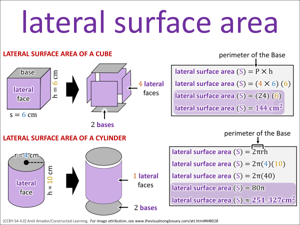
Students might notice in this visual:
- There is a cube and a cylinder
- Some parts of the shapes are purple and some are gray
- There are numbers next to the shapes, like 6 cm and 4 cm
- There are math formulas with letters and numbers
- The final answers have cm² next to them
EXTENDING THE DISCUSSION
After the observational question, randomly call on one or more students to share what they or their partner answered. Then ask the class, “Did anyone notice…?” using the suggestions above or anything else you’ve noticed.
After the observational question, randomly call on one or more students to share what they or their partner answered. Then ask the class, “Did anyone notice…?” using the suggestions above or anything else you’ve noticed.

Students might wonder:
- Why are some sides purple and others gray?
- What do the letters in the formula mean?
- Why does the cylinder have a circle on top?
- Why is one answer a whole number and the other has a decimal?
- What are h and r supposed to stand for?
EXTENDING THE DISCUSSION
After students have shared what they notice, ask the class, “Did anyone wonder…?” using the suggestions above or anything else you might think is interesting or relevant to the lesson.
After students have shared what they notice, ask the class, “Did anyone wonder…?” using the suggestions above or anything else you might think is interesting or relevant to the lesson.
Example student responses
To the observational question, What is lateral surface area?
LOW-LEVEL
Lateral surface area is the area of the sides of a shape.
HIGH-LEVEL
Lateral surface area is the total area of the side faces of a three-dimensional shape, not including the top and bottom bases, and it can be found by multiplying the perimeter of the base by the height of the figure.
RESPONDING TO RESPONSES
Emphasize and celebrate each student’s use of the key vocabulary to support a culture of “no wrong answers.”
Emphasize and celebrate each student’s use of the key vocabulary to support a culture of “no wrong answers.”