
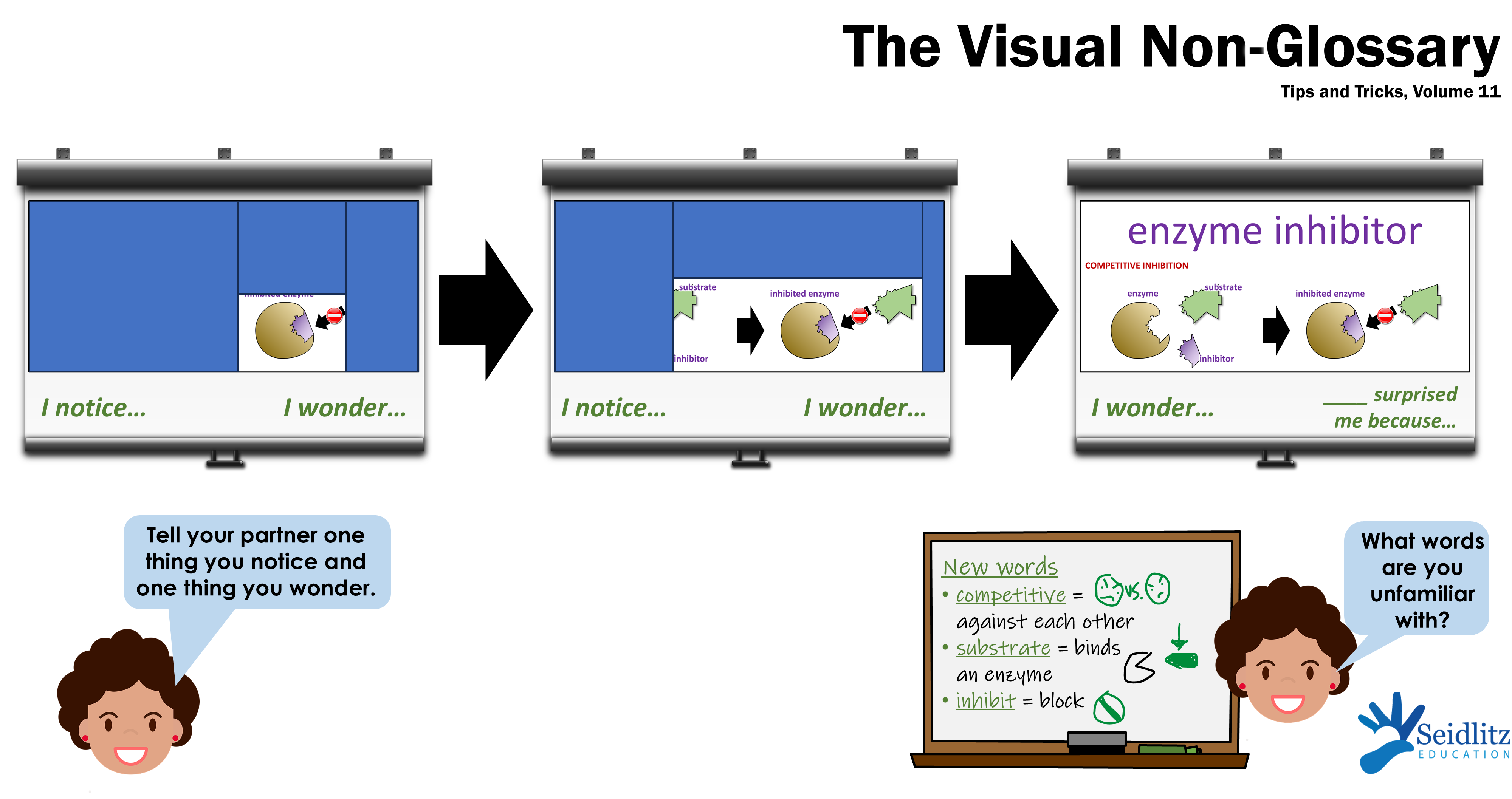
Uncover the Picture
Have a complex visual? Want to quickly engage students at the beginning of the lesson? Try the Uncover the Picture strategy from Teaching Science to English Learners (p.16) by Stephen Fleenor and Tina Beene. Here’s how it works:
- Cover up most of the visual with rectangles, and ask students to write or share verbally what they notice and/or wonder from what they can see.
- Remove one or more rectangles and again ask students to share what they notice and/or wonder.
- Remove all of the rectangles and ask students to share what surprises them and/or what they wonder.
This process builds suspense and makes students focus on key parts of the visual, which builds their ability to make inferences from complex visuals.
Not sure how to do this, technically? See these tutorial videos explaining how to do it in Microsoft PowerPoint or Google Slides.
Identifying Unfamiliar Words
The VNG visuals are designed to focus on a key word (such as enzyme inhibitor) but include other academic words aligned to the standards (competitive, substrate, enzyme, for example). When we ask students to identify unfamiliar words, we can create an anchor chart for the lesson that shows pictures or simple definitions of these words. One method of doing this is:
- Ask students to share with their partner or group any words in this visual which they haven’t seen before or which they’re not sure about in this context.
- Call on students to share whole-class the words they came up with.
- Write down each word on chart paper or a whiteboard as students share them, then give a simple (one- to three-word) definition and/or draw a simple picture representing the word.
- Tell students that these words are going to come up in the lesson again, and they should be sure to refer back to this anchor chart when they see these words.