
Choosing a Reading Passage for the Lesson
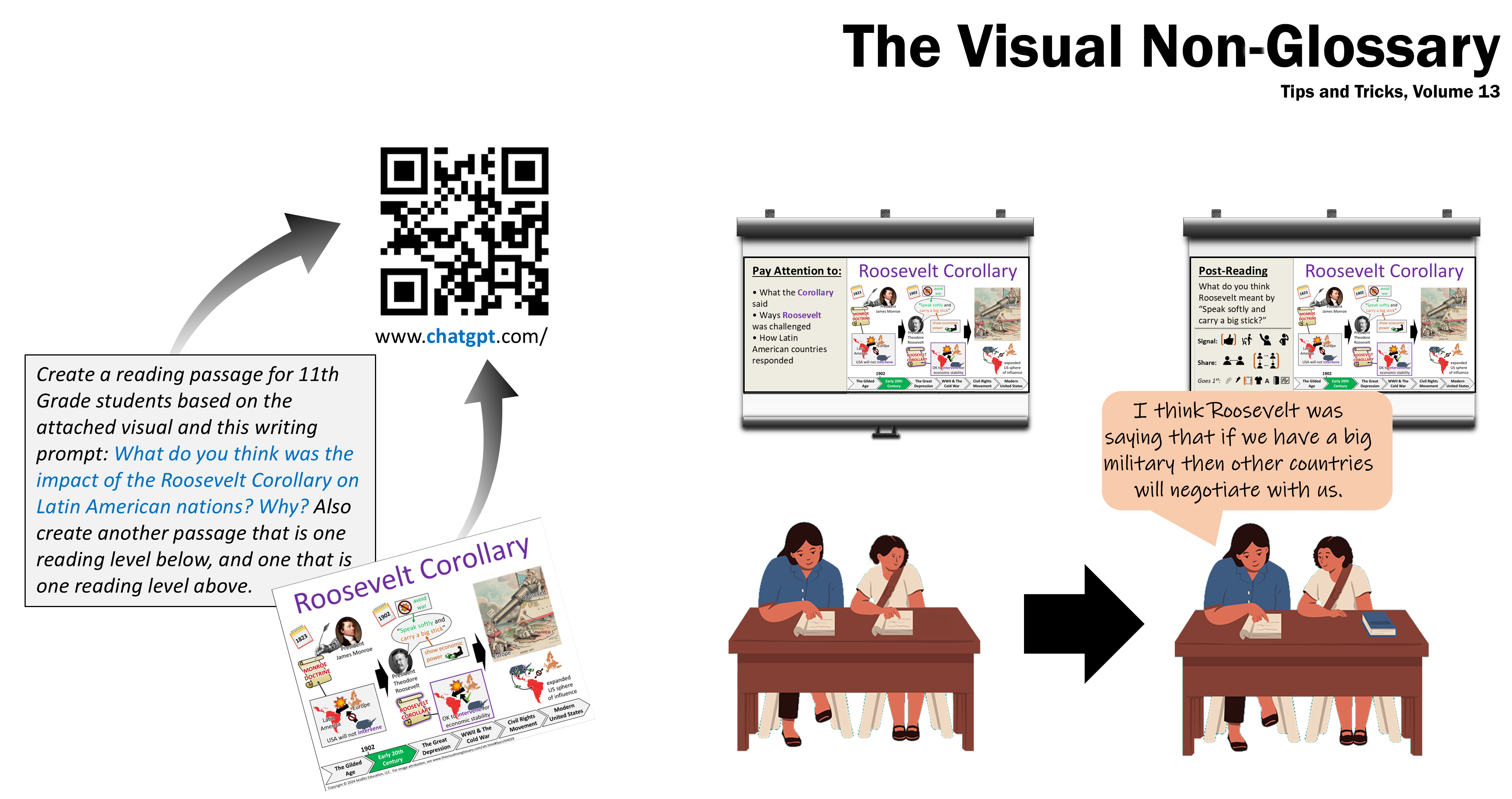
The most effective reading passage is one that is aligned to the objectives of the lesson. In VNG lessons, this is a passage that is directly aligned to the anchor visual of the lesson, and that supports students’ ability to answer the inferential question at the end of the lesson. AI engines such as ChatGPT can be used to quickly create a reading passage that achieves these aims. They can also create additional passages at various reading levels to help differentiate the lesson for struggling or advanced readers. Here is an AI prompt template you can use to generate reading passages:
Create a reading passage for __th Grade students based on the attached visual and this writing prompt: _________ (inferential question). Also create another passage that is one reading level below, and one that is one reading level above.
You might notice that more and more VNG lessons include reading passages. These have been built with AI and edited by our team. You can find these passages in the Downloads section of each word’s page.
Note: it is always important to check the AI’s work for accuracy, length, and cultural sensitivity.
Talk, Read, Talk, Write
This strategy, from the titular book by Nancy Motley (2016), builds comprehension and critical thinking skills by structuring reading around academic conversations and writing. Here’s how to adapt it using The Visual Non-Glossary:
- Talk #1. Show students the structured visual and have them warm up by discussing with a partner or group what they notice and wonder about in the visual. Then, have students answer the observational question in partners or groups using the QSSSA routine.
- Read. Prepare students to read by giving them a list of 3–5 things to pay attention to (a “PAT list”) while reading by highlighting or annotating. Then have students read with the anticipation that they will discuss their reading afterwards.
- Talk #2. Have students discuss the reading with one or more discussion questions in small groups. Importantly, this should be also done with the QSSSA routine. This discussion may include the relational question, if you feel it is appropriate at this point in the lesson.
- Write. Have students discuss the inferential question, then have them write a response in complete sentences using the key vocabulary from the lesson.
For the VNG lessons that include reading passages, you’ll also notice that these lessons follow the Talk, Read, Talk, Write routine!