
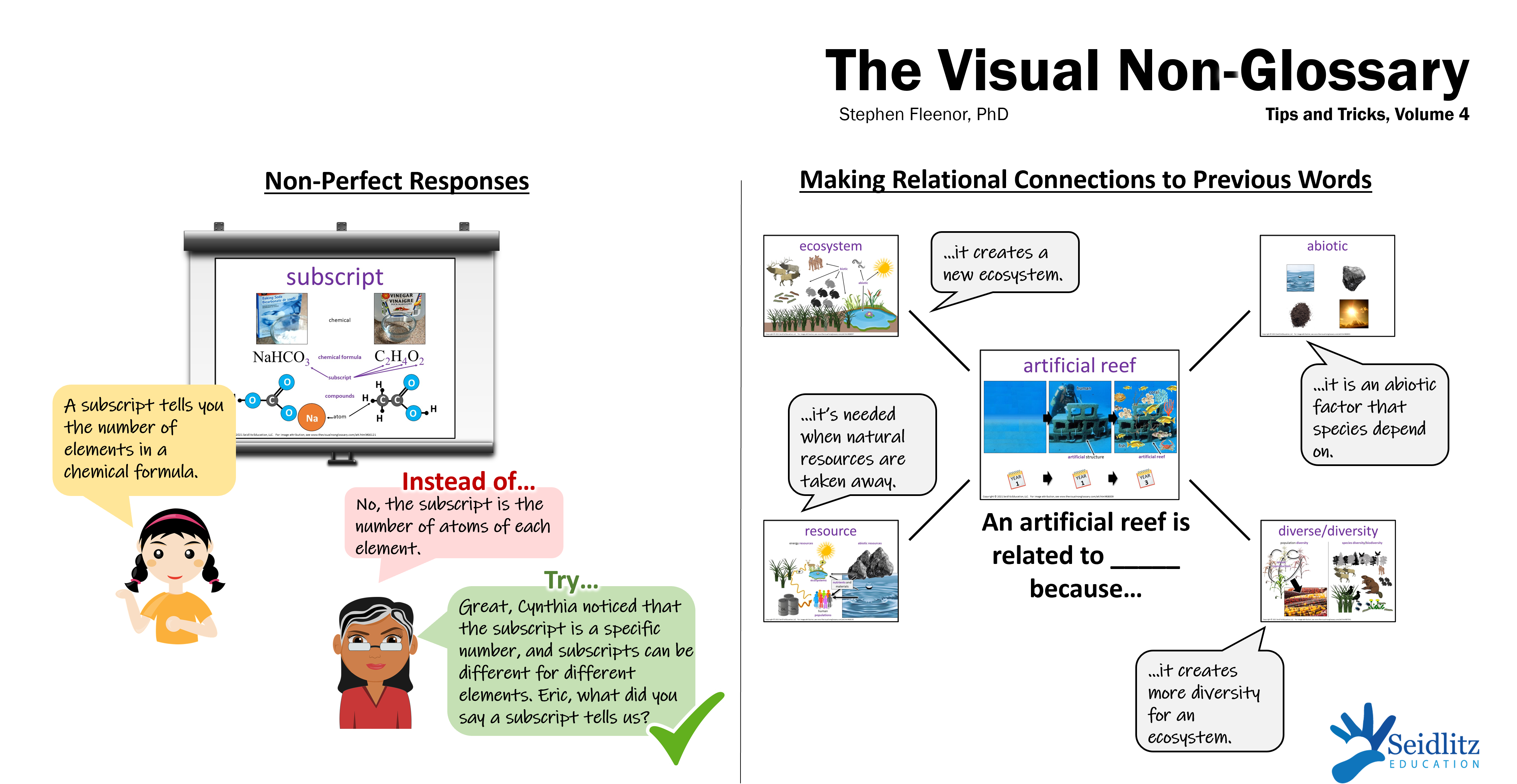
Embrace the Non-Perfect Responses
Many students who respond to the conversation prompts in The Visual Non-Glossary might not have perfect or completely right answers, and that is a good thing! That is because when we call on several students and ask them to share not the right answer, per se, but their most thought-out answer, we create a culture of discussion, deep-thinking, and confidence. When part of a students' response is incorrect or incomplete, highlight the parts of that student's response which were correct, and then call on another student.
For example, if a student (let's call her Cynthia) says "A subscript tells you the number of elements in a chemical formula," instead of responding "No, the subscript is the number of atoms of each element," a teacher might respond: "Great, Cynthia noticed that the subscript is a specific number, and subscripts can be different for different elements. Eric, what did you say a subscript tells us?"
After calling on two or more students, if anything is missing from students' responses, we can always add in details, such as "Did anyone notice that the subscript lets you connect a chemical formula to the structure of a compound?"
Extend Lessons by Having Students Make Relational Connections
After students have discussed the three guiding questions for a certain visual, we can extend their learning by asking them to identify one other word from earlier in the year that this word is related to. Students can discuss the relationship using the sentence stem, _____ is related to _____ because...
For example, a student might say, "An artificial reef is related to diversity because it creates more diversity in an ecosystem" or, "An artificial reef is related to abiotic because it is an abiotic factor that species depend on."